
Uganda's weather isn't one climate — it's five.
Straddling the equator gives Uganda a reputation for consistent warmth, but altitude changes that story completely — the same week can mean glacier-cold mornings in the Rwenzori and 30°C savanna heat in Kidepo. For month-by-month planning, see the Seasonal Safari Calendar; this page covers what the weather actually feels like in each region.
Equatorial, but not uniform
Uganda sits directly on the equator, which means day length barely changes year-round and there's no true winter or summer. What does change is rainfall — the country follows a two-wet, two-dry season pattern typical of equatorial East Africa, with March–May and September–November the wetter stretches, and June–September and December–February the drier ones. Altitude, far more than season, is what actually determines how warm or cold you'll feel.
The Rwenzori and highland cold
The Rwenzori Mountains hold genuine glaciers almost on the equator — temperatures at altitude can drop close to freezing overnight, a fact that surprises most first-time visitors to Africa. Bwindi and Mgahinga, at lower but still significant elevation, run noticeably cool and misty in the early morning, warming through the day; a proper layer for dawn gorilla treks is essential even in the dry season.
Savanna heat in the north and west
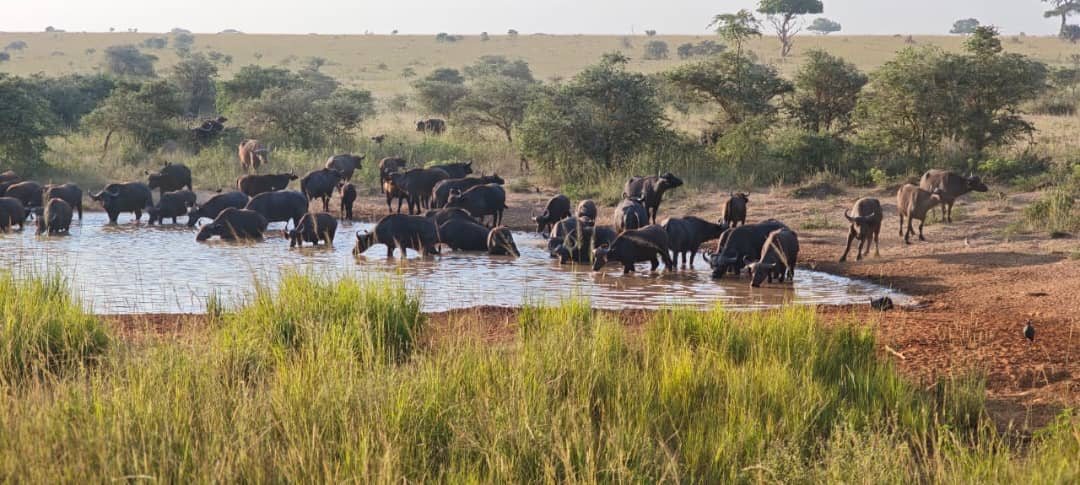
Murchison Falls, Queen Elizabeth and especially Kidepo Valley sit at lower elevation and run considerably hotter — daytime temperatures regularly reach the high 20s to low 30s°C, with Kidepo's semi-arid Karamoja region the driest and hottest corner of the country. Game drives here are timed around the cooler dawn and dusk hours as much for wildlife activity as for comfort.
Lake Victoria basin and the centre
Entebbe, Kampala and the Lake Victoria shoreline sit at a moderate elevation with a milder, more humid climate than either the highlands or the northern savanna — generally the most comfortable, predictable weather in the country, and a gentle place to start or end a trip.
What travellers ask us most.
When is Uganda's rainy season?+
Uganda has two wet seasons — March to May (the longer, heavier one) and September to November (shorter and lighter) — separated by two drier stretches from June to September and December to February.
Does it rain all day during the wet season?+
Rarely — rain typically arrives as a heavy afternoon downpour lasting an hour or two, with clear mornings and evenings still common. Trekking and game drives continue through the wet season, just with muddier trails.
How cold does it get in the Rwenzori Mountains?+
At higher camps and near the glaciers, overnight temperatures can drop close to freezing — a genuine cold-weather kit is necessary for a multi-day Rwenzori trek, unlike almost anywhere else in Uganda.
What's the hottest part of Uganda?+
Kidepo Valley and the surrounding Karamoja region in the north-east, which is Uganda's driest and hottest corner, with daytime temperatures regularly exceeding 30°C.
Still have questions?
Tell us where you're headed and we'll fold the details into your itinerary.